
Users don’t experience models. They experience product decisions.
The mental model that finally made precision and recall click for me.

I kept getting one question wrong.
If Face ID unlocks my phone for a stranger, why is that a False Positive?
In my head, it was obvious. The phone failed to block someone.
Surely that’s a False Negative.
I kept trying to memorise confusion matrices, but nothing really clicked. Until I realised I was looking at the wrong thing.
Model Prediction ≠ Product Behaviour
The breakthrough wasn’t understanding precision or recall.
It was separating what the model does from what the product does.
The model isn’t trying to answer: “Should I unlock this phone?”
It’s answering a much simpler question.“Do I think this is the phone owner?”
If the model is confident enough, it outputs something like: “I think this is the phone owner. Confidence: 96%.”
That’s where the model’s job ends.
The iPhone then takes that prediction and makes a product decision. Should it unlock the phone?
Those are two different things.
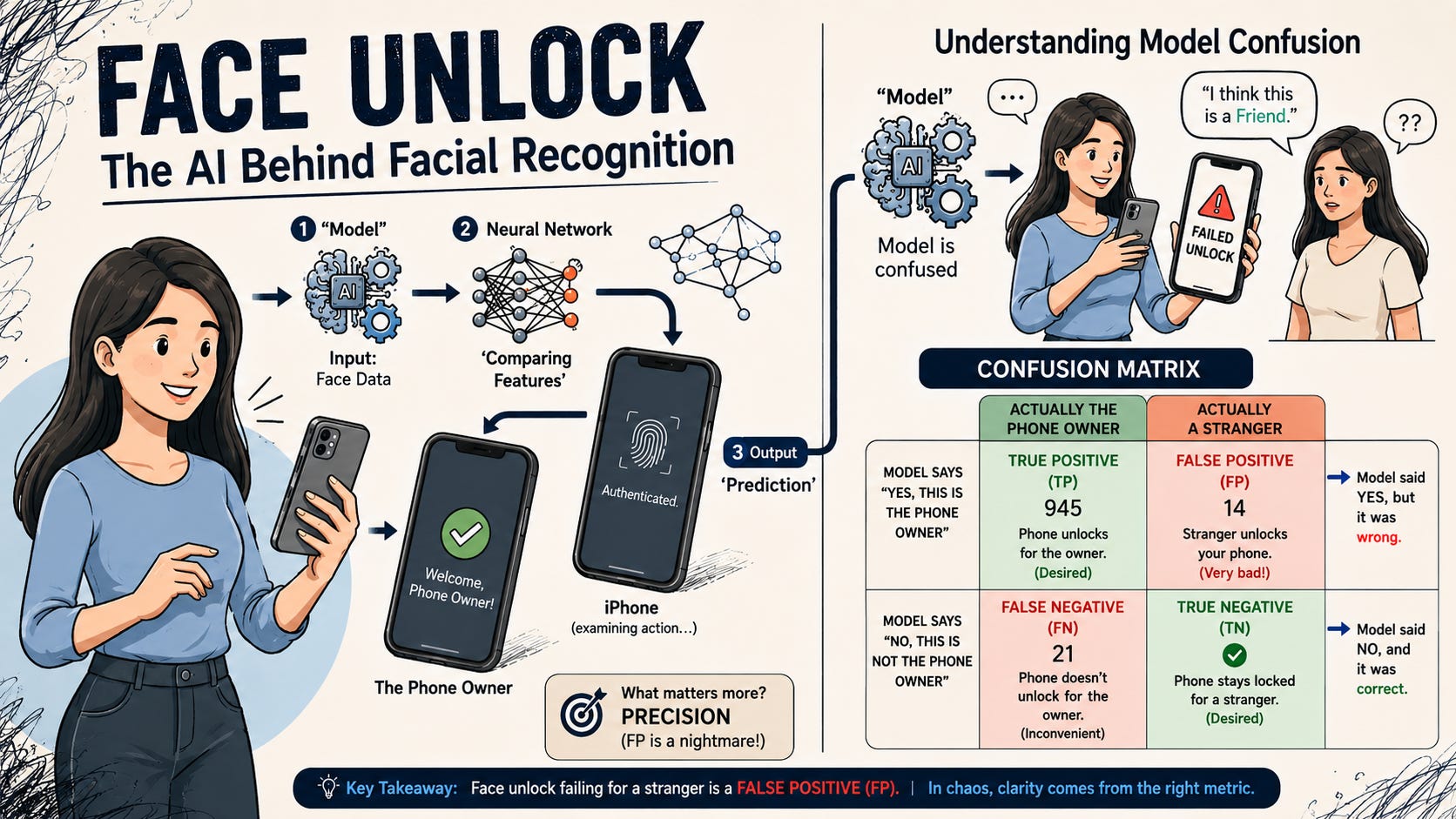
Once I separated those two ideas, the confusion matrix suddenly made sense.
The confusion matrix isn’t built around whether the phone unlocked.
It’s built around what the model predicted.
If the model says “Yes, this is the phone owner.” and it’s actually a stranger, that’s a False Positive.
The phone unlocking is simply the consequence of that prediction.
The model predicts. The product decides.
This isn’t just unique to Face ID.
It’s how almost every AI product works.
An AI Scribe doesn’t directly write into a patient’s medical record.
It predicts things like: “I’m 90% confident the doctor prescribed Metformin.”
The product decides whether to auto-fill it, highlight it for review, or ignore it.
A resume screener doesn’t shortlist candidates.
It predicts: “This candidate has an 83% chance of being a good fit.”
The recruiting product decides whether that score is good enough to shortlist.
Once I started seeing that pattern, I couldn’t unsee it.
So who decides?
Imagine Face ID is only 72% confident that it’s me. Should it unlock?
That’s not a machine learning question. That’s a product question.
And it’s exactly where product strategy begins.
Somebody has to decide where to draw the line.
Too strict, and the phone keeps asking me for my PIN. Too lenient, and it unlocks for someone else.
The model doesn’t choose that threshold. The product team does.
That’s when precision and recall finally clicked.
I used to think precision and recall were properties of the model.
I don’t anymore. They’re properties of the business decision.
Face Unlock.
What’s the more expensive mistake?
A stranger unlocking my phone (False Positive). Or me entering my PIN once (False Negative) ?
The answer is obvious.
A False Positive here is far more expensive. So the product should optimise for high precision.
Now look at a completely different product.
A resume screener.
What’s worse?
Reviewing five extra resumes (False Positive) or missing the perfect candidate (False Negative).
Completely different answer. The False Negative is now more expensive.
So we are now optimising for recall instead.
Different business. Different product strategy.
The same model can power different products.
This was probably my favorite realization.
Imagine two companies using exactly the same resume-scoring model.
The model gives Candidate A a score of 0.83.
Company A decides: Anything above 0.60 gets shortlisted.
Candidate A gets an interview.
Company B decides: Only candidates above 0.90 make it through.
Candidate A is rejected.
Nothing about the model changed. Only the product decision changed.
Precision and recall aren’t just ML metrics. They are a reflection of what the business is willing to tolerate.
I built something to understand this better.
While trying to internalize all of this, I built a tiny simulator.
It doesn’t try to explain precision and recall through formulas.
Instead, you move one slider. The threshold and everything else changes.
You can watch:
False Positives increase.
False Negatives decrease.
Precision move.
Recall move.
More importantly, you start seeing how every movement changes the product, not just the model.
👉 Try the simulator here: https://lnkd.in/gYVMchdh
One thought I can’t stop coming back to.
Users don’t experience models. They experience product decisions.
Maybe that’s where product managers fit into AI after all.
Not in building the smartest model. But in deciding what the product should do with its predictions.